8/29/11

Posted: 28 Aug 2011 02:15 AM PDT
By Matt Stoller, a fellow at the Roosevelt Institute. He is the former Senior Policy Advisor to Rep. Alan Grayson. You can reach him at stoller (at) gmail.com or follow him on Twitter at @matthewstoller
A lot of people have asked why New York Attorney General Eric Schneiderman is going after the banks as aggressively as he is. It’s almost unbelievable that one lone elected official, who happens to have powerful legal tools at his disposal, is doing something that no one with any serious degree of power has done. So what is the secret? What kind of machinations is he undertaking that no one else has been able to do?
I’ve known Schneiderman for a few years, back when he was a state Senator working to reform the Rockefeller drug laws. And my answer to this question is pretty simple. He wants to. That’s it. Eric Schneiderman is investigating the banks because he thinks it’s the right thing to do. So he’s doing it. This guy has thought about his politics. He wrote an article about how he sees politics in 2008 in the Nation, and in his inaugural speech as NY AG he talked about the need to restore faith in both public and private institutions. Free will still counts for something, apparently.
In all the absurdly stupid punditry, the simple application of free will to our elected officials goes missing. Yeah, Obama got money from Wall Street. But Obama is choosing to pursue a policy of foreclosures and bank bailouts not because of any grand corporate scheme. He just wants to. He thinks it’s the right thing to do, and he’s doing it. If you don’t think it’s the right thing to do, then you shouldn’t be disappointed in him any more than you might have been disappointed in Bush. Obama is not trying to do the opposite of what he’s doing, he’s not repeatedly suckered by Republicans, and he isn’t naive or stupid. Obama is simply doing what he thinks is right. So is Eric Schneiderman. So is Tom Miller. So are any number of elected officials out there.
In positions of power, the best expression I heard is that “up there the air is thin”. That is, you have enormous latitude, if you want to use it. Power can be wielded creatively and effectively on behalf of whatever it is the wielder wants. Now of course there are constraints, plenty of them. Smart politicians spend their time working to maximize the constraints they want to impose and weakening the ones they want to overcome. But the basic Reaganite liberal argument defending supplication towards Obama these days is that Obama is “disappointing”. In this line of thought, powerful corporate interests and Republicans are preventing him from enacting what his real agenda would be were he unfettered by this mean machine. Eric Schneiderman, who is in a far less powerful position as New York Attorney General, shows that this is utter hogwash. Obama is who he is, and anyone who thinks otherwise is selling something.
The banking system is really at the heart of our politics, which is why it’s such a great test of one’s political theory of change. I’ve been following the foreclosure fraud story for a few years now, because it’s the tail end of a massive economy-wide fraud scheme that started as early as 2003. The securitization chain failure can’t be put back in the bottle, the housing system it collapsed is simply too big to bail. So elites keep trying to patch this up the way they have everything else. It isn’t working. And their scheme has been obvious and obviously dishonest. Along with Obama (who I criticized as empty as early as 2004, ratcheting this up to dishonest and authoritarian by 2006-2007), I pointed out that Iowa Attorney General Tom Miller was engaged in serious bad faith only a few months after the negotiations started.
I’m no genius, I just listened to what these people actually said and did. Obama mocks the idea that he is an honest politician, overtly, lying about NAFTA and FISA very early on in power. Miller lied to activists about being willing to put bankers in jail, and then said he was negotiating with banks in secret. It was overt. For Miller, as with Obama, few people really picked up on the lies until recently. Iowa activists who heckled Miller got it, as did Naked Capitalism readers. Now it’s becoming more and more obvious. That’s just how it is, I suppose, people in the establishment are paid to not notice corruption until the harsh glare is too bright.
The crazy thing is that robosigning is apparently still going on. Right now, the “settlement” talks are the equivalent of law enforcement negotiating with a serial killer over whether he’ll get a parking ticket, even as he continually sprays bullets into the neighborhood. Even having these “settlement” talks when the actual crimes haven’t been investigated or a complaint hasn’t been registered should be example enough that this process is rigged as badly as Dodd-Frank. It should not be a surprise that the administration is putting pressure on Eric Schneiderman, that Tom Miller is kicking him out of the club house. That’s who these people are. It’s what they believe in. Just as it should not be a surprise, though it is laudable, that Schneiderman isn’t knuckling under to the administration. I suspect he probably is laughing at the idiocy of Miller’s pressure tactic. I mean, this is a guy going up some of the most powerful entities in the United States: Bank of New York Mellon, Bank of America, the New York Fed, etc. And the Iowa Attorney General isn’t going let him on conference calls? Mmmkay.
When you look closely at most significant areas of government, it becomes clear that the President and his administration are enormously powerful actors who get a lot done. Handing over our national wealth to the banks and to China is not nothing. These people are reorganizing the economy and the political system so that there are no constraints on the oligarchical interests that fund and pay them. That is their goal, it has been their goal from day one (or even before that), and anyone who says otherwise is just wrong or deluding him or herself. Obama spoke at the founding of Robert Rubin’s Hamilton Institute, and his first, and most important by far policy initiative, was his whipping for TARP, a policy that was signed by Bush but could not have passed without Obama getting his party in line. That was his goal, and he’s still pursuing it. The numerous “what happened to Obama” wailing editorials overlook the consistency of his policy agenda, which stretches back years at this point.
If someone worked or works for the Obama administration, or the Department of Justice, or any other executive branch agency, they need to remember their service as a mark of shame for the rest of their lives. Remembering how they participated in this example of how to govern is literally the least they could do for the damage they have caused. I would leave out the small number of people who are there to overtly prevent as much damage as possible, and those who resign or are fired in protest.
For the rest of the Democratic Party, well, reality is just beginning to intrude into the fantasy-land of partisans, even though the 2010 loss should have delivered a searing wake-up call to the failure Obama’s policy agenda. From 2006-2008, the Bush administration’s failures crashed down upon conservatives, and they in many ways could not cope. But their intellectual collapse was bailed out by Obama. Faux liberals are seeing their grand experiment in tatters, though right now they can only admit to feeling disappointed because the recognition that they have been swindled is far too painful. And the recognition for many of the professionals is even more difficult, because they must recognize that they have helped swindle many others and acknowledge the debt they have incurred to their victims. The signs of coming betrayal were there, but in the end it all comes down to judging people based on what they do and who they choose as opponents. And this Democratic partisans did not do, choosing instead a comfortable delusional fantasy-land where foreclosures don’t matter and theft enabled by Obama (and Clinton before him) doesn’t matter.
Eric Schneiderman’s willingness to go after the banks and stand up to the corruption of the Bush and Obama administrations should be a reminder to all of us of this. We have free will. He is doing the right thing for no other reason than because he wants to, because he believes in it. He is going to face serious consequences for this, very nasty stuff. Eliot Spitzer was taken down and his name dragged through mud because of who he took on. Paying ugly costs for standing up is routine, unfortunately, in modern America. And the least powerful among us face far worse consequences than politicians who are embarrassed. But integrity exists, and Schneiderman is showing that free will can be exercised in its service. This fact is true of many people, not just Schneiderman; Bill McKibbin, Jane Hamsher, Dan Choi and others just got arrested in front of the White House to register dissent. So next time someone tells you that you have no choice but to support one of the two branches of the banking party, just remember, you also have free will. And the only person who can take that away from you, is you.

via:NakedCapitalism/Yves Smith


Posted: 27 Aug 2011 10:22 PM PDT
Yves here. This short piece by Robert Gordon is important because it seeks to quantify the impact of a phenomenon that economists have noticed a bit late in the game: that the benefits of GDP growth, which used to go mainly to labor (via increased hiring and better wages) now benefit capitalists fare more than ordinary workers. The shift towards increases in GDP favoring corporate profits at the expense of labor became pronounced in the weak Bush expansion (we commented on it in a 2005 article) and Gordon’s effort to try to translate that into the impact on unemployment levels is a useful step forward in the debate.
By Robert Gordon, Professor in the Social Sciences and Professor of Economics at Northwestern University. Cross posted from VoxEU
The US is missing millions of jobs. This column argues that the total is 10.4 million. It claims that 3 million of these can be traced to the weakened bargaining position of labour and the growing assertiveness of management in slashing costs to maintain share prices. Moreover, this employment gap is not shrinking because of the ‘double hangover’ effect—an excess housing supply and besieged consumers unwilling to spend.
High and persistent unemployment in the US has emerged as one of the most important macroeconomic legacies of the 2007-09 world economic crisis. While the decline of business activity in the US was no larger than in Europe, the US is an outlier in its outsized response of the unemployment rate to its decline of output (IMF 2011).
Here we quantify the shortfall of US employment – some 10.4 million missing jobs – and ask: Why did the number of jobs decline so much and why has it recovered so little? Two sets of causes stand out.
First, there has been a changing balance of economic power in the US between management and labour in the past two decades that has led to more aggressive firing of workers when business profits head south.
Second, the large negative output gap (actual real GDP below trend or potential) is not shrinking, due to the “double hangover” persisting in the aftermath of the housing bubble.
By explaining why the recovery of aggregate demand has been so weak, we provide an understanding of the refusal of the large negative output gap to shrink – a refusal shared by its twin, the employment gap.
Dimensions of the job shortfall: 10.4 million missing jobs in the recovery
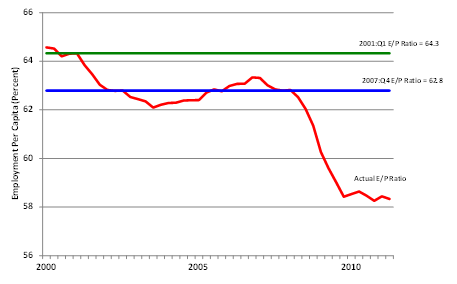
Part of the job shortfall is reflected in the rise of measured unemployment. The rest comes from a decline in labour-force participation. The employment-population ratio (hereafter E/P) measure combines the two.1 As shown in Figure 1, the ratio (as shown by the green line) was 64.3% at the NBER business-cycle peak in 2001:Q1. By the next peak (2007:Q4) it had fallen to 62.8% (blue line).
This descent from 64.3% to 62.8% led numerous commentators to lament that the 2001-07 US economic recovery was not a complete recovery. Indeed, the seemingly ‘minor’ 1.5% drop in the ratio represents more than 3.6 million ‘missing’ jobs – even before the recent recession.
In mid-2011, the ratio (wavering red line) is only 58.1% — far below 2001 and 2007 levels.
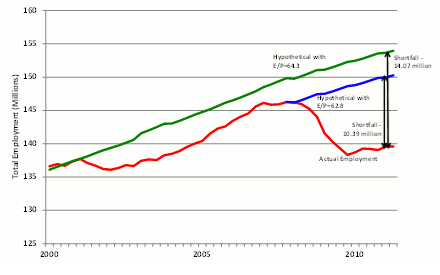
How many jobs are lacking? Figure 2 shows that the shortfall amounts to 10.4 million missing jobs compared to the 2007 version of normality and a much higher 14.1 million missing jobs compared to the 2001 definition. In the rest of this analysis, we take the less ambitious 2007 value for the ratio of 62.8% as the relevant benchmark.
Figure 1. Actual vs two criteria of normal employment per capita, 2000:Q1-2011:Q2

Figure 2. Actual vs hypothetical employment, 2000:Q1-2011:Q2

What caused the destruction of 10.4 million jobs?
The first explanation is the change in managerial power. For decades I have been tracking the responsiveness of labour-market variables to the output gap (see most recently Gordon, 2003, 2010).
Before the mid-1980s a 1% change in the output gap would generate roughly a response of 0.45% in the similarly defined gap of the Employment Population ratio.
The rest of the 1% shortfall of real GDP would show up in declining productivity and in hours per employee.
The observed ratios in the data for 1954-86 are roughly consistent with the predictions made by Arthur Okun (1962) in what soon became christened as “Okun’s Law.”
After the mid-1980s, however, these responses changed in a process I have described as the “Demise of Okun’s Law.” The response of the ratio jumped from 0.45 in the 1954-86 interval to 0.78 in an otherwise identical regression equation applied to 1986-2011. This means that when output slumps, employment drops much more than it would have done previously.
The “disposable worker hypothesis”
When the economy begins to sink – like the Titanic after the iceberg struck – firms begin to cut costs any way they can; tossing employees overboard is the most direct way. For every worker tossed overboard in a sinking economy prior to 1986, about 1.5 are now tossed overboard. Why are firms so much more aggressive in cutting employment costs? My “disposable worker hypothesis” (Gordon, 2010) attributes this shift of behaviour to a complementary set of factors that amount to “workers are weak and management is strong.” The weakened bargaining position of workers is explained by the same set of four factors that underlie higher inequality among the bottom 90% of the American income distribution since the 1970s – weaker unions, a lower real minimum wage, competition from imports, and competition from low-skilled immigrants.
But the rise of inequality also has boosted the income share of the top 1% relative to the rest of the top 10%. In the 1990s corporate management values shifted toward more emphasis on shareholder value and executive compensation, with less importance placed on the welfare of workers, and a key driver of this change in attitudes was the sharply higher role of stock options in executive compensation. When stock market values plunged by 50% in 2000-02, corporate managers, seeing their compensation collapse with profits and the stock market, turned with all guns blazing to every type of costs, laying off employees in unprecedented numbers. This hypothesis was validated by Steven Oliner, Daniel Sichel, and Kevin Stiroh (2007), who showed using cross-sectional data that industries experiencing the steepest declines in profits in 2000-02 had the largest declines in employment and largest increases in productivity.
Why was employment cut by so much in 2008-09? Again, as in 2000-02, profits collapsed and the stock market fell by half. Beyond that was the psychological trauma of the crisis; fear was evident in risk spreads on junk bonds, and the market for many types of securities dried up. Firms naturally feared for their own survival and tossed many workers overboard.
3 million missing jobs due to altered management response to recession
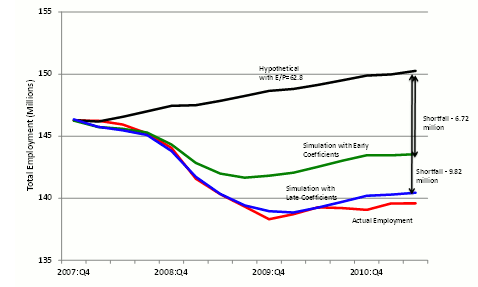
Figure 3 provides the results of a simple experiment regarding the loss of jobs.
Labour-market responses to business-cycle shortfalls were quite different when estimated with regressions over the 1954-1986 (“early”) and 1986-2011 (“late”) sample periods.
Responses of employment and other labour market variables were much larger in the “late” period (as predicted by the disposable worker hypothesis).
Given the decline in the output gap, simulated employment fell short by 9.82 million with the “late” dynamic adjustment behaviour, quite close to the 10.39 million actual shortfall. Yet with the “early” coefficients employment fell by a substantial but significantly smaller total of 6.72 million.
Figure 3. Actual vs hypothetical and dynamic simulation employment, 2007:Q4-2011:Q2

Thus labour’s weakened bargaining situation with changes in management behaviour toward greater emphasis on cost-cutting in recessions accounts for roughly 3 million lost jobs in the current jobless recovery. The other 6.72 million would have been lost even with the earlier responses because the output gap was so large.
Why is aggregate demand so weak? The ‘double hangover’ explanation
This explains the outsized job cuts that came in response to the recession. But we are still left with the question of explaining why the output gap is still so negative 2 years after the NBER business-cycle trough (June 2009).
America’s double hangover goes back to the consumption binge that accompanied the 2000-06 housing bubble.
The residential construction industry was building houses at a pace much higher than the underlying rate of household formation.
Housing demand was boosted by speculators who bought new condominiums hoping to “flip” them for easy profits and by mortgage brokers who were out combing the weeds for low-income families to whom they could peddle dangerous adjustable-rate interest-only mortgages.
Consumption of all types, particularly of durable goods like autos and appliances and services like nail salons and child tutoring, grew faster than income, implying an ever-declining personal saving rate.
Households could use not only their own income to buy consumer goods and services but could finance expenditures in excess of income through second mortgages and refinancing that allowed them to drain cash from their appreciating residences.
Once the bubble burst and house prices began to tumble, the ‘double hangover’ began.
The first hangover was the excess supply of housing.
This led to a glut of unsold houses and condos that put continuous downward pressure on home prices. Foreclosures added to the glut; each foreclosure raises the supply of vacant housing units by one unit while increasing the demand for housing units by zero, because the foreclosed family has by definition defaulted on its mortgage and cannot obtain credit for several years into the future. Many homeowners avoided foreclosure but were “underwater,” with houses now worth less than the face value of the mortgage and thus faced the hapless choice of draining resources to pay the mortgages or defaulting, with the consequence of a ruined credit rating.
The second hangover was the impact of excessive indebtedness.
Just as consumption could exceed income as debts were being run up, so the second hangover required consumption to be below income while debts were paid off. The ratio of total household indebtedness to personal disposable income rose from 90% in 1995 to 133% in 2007 and has since fallen just to 120%. Year after year of saving and underconsumption will continue as households continue to pay off debts.
Just as hangovers have negative impacts on family members and job performance, so the double hangover of the slump in residential housing investment and in personal consumption expenditures has spilled over to other components of GDP. Nonresidential investment was hit as firms supplying consumers and home builders reduced their need for new computers, machinery, factories, office buildings, and hotels. State and local governments, by law required to balance their current budgets, began to lay off school teachers and other employees.
Dissecting the shortfall of aggregate demand
We now turn to the “shortfall” of each component of aggregate demand.
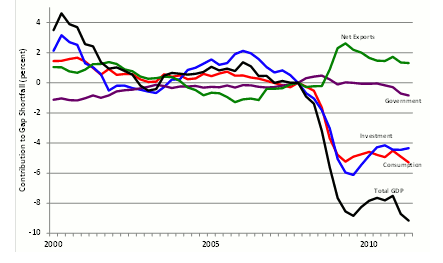
The shortfall is defined relative to the previous business-cycle peak in 2007:Q4, so if the ratio of a component of spending to potential GDP has declined by 3.0% between 2007:Q4 and 2011:Q2, we describe its shortfall as 3.0%.
The sum of all these shortfalls adds up to the -9.2% output gap.
Figure 4 illustrates the gap shortfall relative to normal for total GDP and its four major spending components. The total gap shortfall is shown by the black line and is divided into the shortfall of consumption (red), investment (blue), government spending (purple), and net exports (green).
Consumption and investment are roughly tied in their contribution at about -5% of potential GDP,
Government makes a small negative contribution; and
Net exports make a substantial positive contribution.
Notice that in 2000 and again in 2005-07 the total gap was positive rather than negative, and this was mainly attributable to a positive gap for equipment investment in 2000 and housing investment in 2005-07.
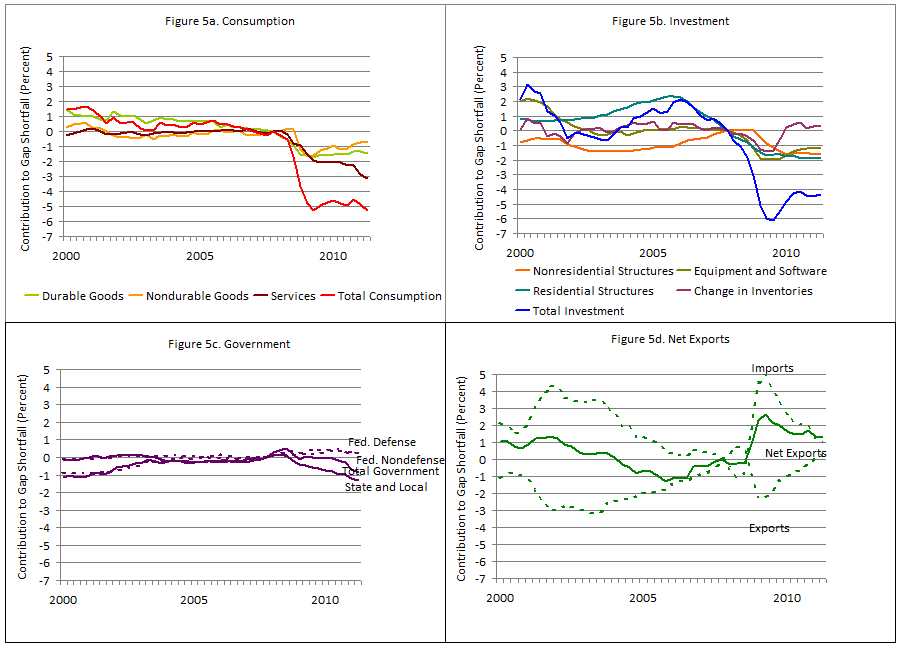
Four graphs in the addendum (see Figures 5a-5d below) show the subcomponents of the four main types of spending. The surprising result that by far the biggest part of the consumption shortfall is provided by services, which has more than twice the shortfall of durable goods. Over the past two quarters the consumer-services shortfall has become even larger. The services and durables gaps were positive for the entire period between 2000 and 2006, indicating that easy credit and cash-out refinancing were used for consumer services, not just to finance consumer durables.
Figure 4. Components of gap shortfall, 2000:Q1-2011:Q2

In contrast to the overall consumption shortfall – which continues to be as negative as in early 2009 – the total investment shortfall is somewhat smaller now. Surprisingly the current shortfall for nonresidential construction is almost as large as for residential construction. This occurs because much of the collapse of residential construction had already occurred between 2006:Q1 and 2007:Q4.
Figure 5c (below) decomposes government spending into state and local government spending, federal military, and federal nonmilitary spending on goods and services. Transfer payments, including unemployment compensation and social security payments, are by definition excluded from GDP. Total government spending’s contribution to the output gap was positive in 2008, neutral in 2009, and has become increasingly negative (i.e., contributing to the overall shortfall in total GDP) since early 2010. The small positive contribution of the two federal government components has been more than cancelled by declining state and local spending.
Net exports (Figure 5d below) have helped to offset the shortfall in the other spending components. In 2011:Q2 exports returned to the same ratio of potential GDP as in 2007:Q4, i.e., the total of real exports in the past 3.5 years has grown as much as potential real GDP (that is, by 9%). Imports, which are a subtraction from real GDP, have not recovered to their ratio to natural real GDP and thus have prevented the total output gap from being larger than it is. Without the contribution of the decreased level of imports, the total output gap would have been -10.2 instead of -9.2%.
Translating lost spending into lost jobs
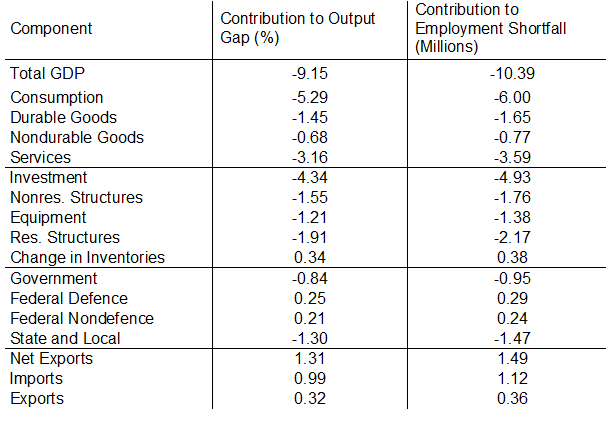
Table 1 lists the major components of spending and the subcomponents and displays the percentage shortfalls already displayed in Figures 4 and 5. Then we use the shares of each subcomponent in the total output shortfall to calculate the jobs shortfall for each subcomponent. Notice that this method treats all components of spending as equally labour-intensive, an acceptable approximation for this exercise. It includes in the jobs shortfall attributable to, say, residential structures, not just the construction jobs in the residential industry but all the jobs involved in raw materials and intermediate inputs to that industry, including lost jobs in providing lumber, nails, tools and equipment, heating and cooling equipment, built-in appliances, and more.
The shortfall of consumer-services spending is the largest subcomponent; it translates into 3.59 million missing jobs.
Next come the 2.17 million lost jobs in residential construction (on top of those lost between 2006:Q1 and 2007:Q4),
the 1.76 million in nonresidential structures,
1.65 million in consumer durables,
1.47 million in state and local government, and
1.38 million in equipment and software.
The overall simulated job shortage would have been 11.88 million but for the helpful performance of net exports. It’s positive contribution brings the figure to a smaller but still unfortunate 10.39 million.
Table 1. Contribution of GDP components to output gap and employment shortfall, 2011:Q2

Conclusion
A change in labour market dynamics accounts for about 3 million of the over 10 million missing jobs in mid-2011. This shift can be traced to weakness of labour and growing assertiveness of management. But even with the labour-market institutions of 1955 through 1985, the weakness of aggregate demand in the recession and recovery would have cost roughly 7 million jobs instead of the 10 million jobs that are actually missing compared to normal economic conditions such as occurred in 2007.
The recession itself is usually and correctly traced to the collapse of the housing bubble and the post-Lehman financial panic. But the recovery has been unusually weak, completely unlike the economy’s rapid bounce-back in 1983-84, and this requires an explanation as well. The best place to start is the double hangover approach, which explains not just the collapse of residential structures investment but also the continued and growing weakness in consumer spending. Perhaps the most surprising result of this essay is that the spending component responsible for the largest share of the missing jobs is not residential investment but consumer spending on services.
This is not the place to talk about remedies.
The spending decomposition shows that fiscal policy has failed in that the government spending sector has made the output gap shortfall worse, not better.
The double hangover theory helps to explain why monetary policy is impotent, no matter how much “Quantitative Easing” is attempted.
Authors including Hall (2011) focus on the zero lower bound as the crux of the Fed’s problem and ignore the complementary problem of low interest-insensitivity of consumers who are trying to pay off old debt instead of taking on new debt.
The failure of consumer and investment spending to respond to an ever-lower 10-year government bond rate, which fell below 2.3% this past week, demonstrates that the problem is an “IS” curve that is very steep if not vertical at an output level far below that necessary to generate a normal level of employment. The vertical IS curve is just as relevant for understanding today’s economy as that of the 1930s, and it plays an essential role in the twelfth edition of my macro textbook (2012) in explaining why monetary policy may at times be impotent, just as it did in the first edition more than three decades ago.
Addendum: Details on the aggregate demand shortfall (click to enlarge)

8/25/11

http://msjnews.net/
a great new journal proud to be partners with... look for figgdimension


uploading our pics that got deleted thanks for understanding :) enjoy the review !!!

8/23/11


via: Naked Capitalism/Yves Smith
Posted: 21 Aug 2011 01:52 AM PDT
The 40th anniversary of the Powell memo is this Tuesday, August 23. Louis Powell’s document articulated a vision and major elements of a plan for how major corporations would reshape social values to produce a milieu more conducive to their interests. As Bill Black wrote:
He issued a clarion call for corporations to mobilize their economic power to further their economic interests by ensuring that corporations dominated every influential and powerful American institution. Lewis Powell’s call was answered by the CEOs who funded the creation of Cato, Heritage, and hundreds of other movement centers.
The result was arguably the most successful proselytization in history. And conservatives are not resting on their laurels. One ongoing effort is to cement right wing values by embedding them in the educational process. As we pointed out in ECONNED and here, that strategy reaped enormous rewards in the law arena. The once fringe law and economics movement, which sought to embed the ideas of neoclassical economics in the legal discipline, is now mainstream, and has served the big businesses who funded this push very well.
The Koch brothers are backing a push deeper into the educational process. One example is the firestorm that erupted over a $1.5 million donation to Florida State University’s economics department. While funding faculty chairs is hardly unusual, the university makes its own appointment decisions. Not here, though. The Kochs trampled over principles of academic freedom in their program on “political economy and free enterprise.” Per the St. Petersburg Times:
Under the agreement with the Charles G. Koch Charitable Foundation, however, faculty only retain the illusion of control. The contract specifies that an advisory committee appointed by Koch decides which candidates should be considered. The foundation can also withdraw its funding if it’s not happy with the faculty’s choice or if the hires don’t meet “objectives” set by Koch during annual evaluations.
David W. Rasmussen, dean of the College of Social Sciences, defended the deal, initiated by an FSU graduate working for Koch. During the first round of hiring in 2009, Koch rejected nearly 60 percent of the faculty’s suggestions but ultimately agreed on two candidates. Although the deal was signed in 2008 with little public controversy, the issue revived last week when two FSU professors — one retired, one active — criticized the contract in the Tallahassee Democrat as an affront to academic freedom.
The Orwellian twist to all of this is the repurposing of the word “freedom”. “Freedom” is historically a political idea: freedom from oppression. The idea of economic freedom as promoted by libertarians and Chicago School economists, is ultimately hostile to political freedom. Chile under Pinochet, which was a Chicago School experiment, was proof: as one survivor said, “People died so markets could be free.” The Citizens United version of economic freedom means that businessmen can buy political influence with no restrictions. We can see how well that is working out in the US. The level of corruption has gone from being tolerable to rampant in a remarkably short period of time. By contrast, in Australia, a few requirements that are impossible to implement here, like prohibiting paid political ads on TV and having voting be mandatory, has put a damper on influence peddling.
Now that the Kochs have come under more scrutiny, they’ve gotten stealthier in how they proceed. The Tucson Weekly described how the Kochs were funding a “Freedom Center” in the Philosophy Department (!) at the University of Arizona. Unlike the Florida State University initiative, the new center is headed by a 15 year faculty member who is firmly libertarian, which presumably takes care of the need for the Kochs to hover over their baby and make sure it hews to their ideology. In fact, this “center” has the potential to become a right wing think tank under university auspices, which would be a new, ugly beast.
While the article quotes some sources that insist that the new center will be independent, they are all people who are direct beneficiaries, such as the head of the center and the dean of the college who presumably gains in stature from securing more funding. Other faculty members were skeptical:
“I think it’s problematic for academics, and creates potential conflicts of interest,” says David Gibbs, a professor of history and government in the UA’s Political Science Department….
[H]e sees it as “deep lobbying,” or an attempt to place the seal of academic legitimacy on their extremist libertarian views.
“When you think of lobbying,” he says, “you think of a lobbyist coming in to twist a congressman’s arm over a particular piece of legislation. But deep lobbying is where you influence the whole climate of opinion. And that’s what is going on here.
“It’s a very long-term project,” Gibbs says. “Since the 1970s, a lot of rich individuals have been trying with great success to shift the climate of opinion radically to the right. The Koch brothers, of course, have become famous for doing that. There’s really nothing comparable on the left.”
That dovetails perfectly with the Freedom Center, which Gibbs labels “a libertarian think-tank with window dressing.”…
Regardless of who donates what, some find the cash-strapped university’s increasing reliance on outside funding troublesome. Among them is Rachana Kamtekar, an associate UA philosophy professor with no ties to the Freedom Center. “It’s not always going to be possible to ensure that the sources of money are clean,” Kamtekar says. “And that’s the problem with big money. A lot of it is not clean.”….
“The use of the money here is something that I think poses serious problems,” he [Gibbs] says. “In academics in general, and especially in philosophy, debates are supposed to be decided on the merits—that the stronger argument, the one with more weight and logic behind it, should prevail. But what’s going on here has nothing to do with the quality of argument.
“This has to do with money,” he says. “And in my view, that poses very serious problems for the integrity of scholarship.”
Oscar Wilde described a cynic as someone who knew the price of everything and the value of nothing. And as pretty much everything in American society now seems to have a price on it, it looks like we may have perilous little of value left.

8/18/11


Posted: 17 Aug 2011 02:08 PM PDT
Matt Taibbi has published yet another serious expose, and this one is appalling in that it shows how long standing and deeply institutionalized the “nothing to see here” practices are engrained at the SEC.
This is the guts of the article:
For the past two decades, according to a whistle-blower at the SEC who recently came forward to Congress, the agency has been systematically destroying records of its preliminary investigations once they are closed. By whitewashing the files of some of the nation’s worst financial criminals, the SEC has kept an entire generation of federal investigators in the dark about past inquiries into insider trading, fraud and market manipulation against companies like Goldman Sachs, Deutsche Bank and AIG. With a few strokes of the keyboard, the evidence gathered during thousands of investigations – “18,000 … including Madoff,” as one high-ranking SEC official put it during a panicked meeting about the destruction – has apparently disappeared forever into the wormhole of history….
It goes without saying that no ordinary law-enforcement agency would willingly destroy its own evidence. In fact, when it comes to garden-variety crooks, more and more police agencies are catching criminals with the aid of large and well-maintained databases.
Don’t underestimate the seriousness of these charges. The SEC’s own staff has admitted that this behavior may well be criminal, and the agency has responded to inquires with remarkably obfuscatory replies, which is usually a official sign that the facts are ugly.
Not only is this conduct appalling, but the timeline is revealing. It apparently dates to at least 1993, when Clinton appointee Arthur Levitt became chairman. This is well before most people would date Wall Street having much impact on undermining regulation (although if my memory serves me right, a significant first step was the Greenspan Fed abandoning oversight of primary dealers, which took place in 1992). Levitt was from Wall Street, he had been the chairman of the American Stock Exchange. But he has tried to wrap himself in the mantle of being the friend of the small investor and blamed the erosion of the SEC on regular threats by Congressmen like Joe Lieberman, the Senator from Hedgistan, who found this stance to be too much and threatened to cut SEC funding. It isn’t clear if the practice started under Levitt, but Levitt notably was the first SEC chairman for decades who was not an attorney. His history in the industry and his lack of legal expertise was questioned as being likely to weaken the agency, and with the benefit of hindsight, that effort may have been more deliberate and wideranging.
This evidence of an institutionalized effort to change the playing board in favor of the financial services industry puts an entirely different coloration on Levitt’s posture. It now looks like a precursor to the Obama playbook of giving the industry virtually everything it wanted on what counts (Levitt sided with Rubin and Greenspan in opposing regulation of credit default swaps) but engaging in some “friendly to the public” gestures to hide that fact from the Democratic base. And it’s hard to believe now, but in 1993, both the rule of law and propriety carried much more weight than they do now. It’s hard to imagine that those involved were ignorant of the significance of these measures, and the fact that they continued for 20 years before anyone called them out points to a deeply corrupt culture at the SEC.
I’m not easily shocked, but this is shocking. It’s like discovering your a colleague didn’t merely have some problems with his taxes, but was money laundering on behalf of a major drug ring. I hope the Taibbi piece leads to a much broader look into dubious practices at the SEC. But given how the banks seem to own DC, I’m not holding my breath.


Land of the Free?  Home of the Poor...  a PBS special w/Warren Buffet
cross-posted via: Forbes

The U.K. Riots And The Coming Global Class War


LONDON, ENGLAND - AUGUST 10:  Prime Minister D...
Image by Getty Images via @daylife
The riots that hit London and other English cities last week have the potential to spread beyond the British Isles. Class rage isn’t unique to England; in fact, it represents part of a growing global class chasm that threatens to undermine capitalism itself.
The hardening of class divisions    has been building for a generation, first in the West but increasingly in fast-developing countries such as China. The growing chasm between the classes has its roots in globalization, which has taken jobs from blue-collar and now even white-collar employees; technology, which has allowed the fleetest and richest companies and individuals to shift operations at rapid speed to any locale; and the secularization of society, which has undermined the traditional values about work and family that have underpinned grassroots capitalism from its very origins.
All these factors can be seen in the British riots. Race and police relations played a role, but the rioters included far more than minorities or gangsters. As British historian James Heartfield has suggested, the rioters reflected a broader breakdown in “the British social system,” particularly in “the system of work and reward.”

In the earlier decades of the 20th century working class youths could look forward to jobs in Britain’s vibrant industrial economy and, later, in the growing public sector largely financed by both the earnings of the City of London and credit. Today the industrial sector has shrunk beyond recognition. The global financial crisis has undermined credit and the government’s ability to pay for the welfare state.
With meaningful and worthwhile work harder to come by — particularly in the private sector — the prospects for success among Britain working classes have been reduced to largely fantastical careers in entertainment, sport or all too often crime. Meanwhile, Prime Minister David Cameron’s supporters in the City of London may have benefited from financial bailouts arranged by the Bank of England, but opportunities for even modest social uplift for most other people have faded.

Here it comes.  CNET's reporting that the House is about to introduce its own version of the Internet Blacklist Bill.
Will you urge your friends to demand that Congress reject this awful legislation?  You can use these links:
[fb] If you're already on Facebook, click here to share with your friends.
[fb] If you're already on Twitter, click here to tweet about the campaign: Tweet
Here's CNET:
[Bob] Goodlatte, a leader in Congress on technology policy, told a crowd of over a hundred that the House is working on its own version of the Senate bill....The House bill will be introduced in the next few weeks, and hearings will be scheduled for mid-September, Goodlatte said.
The Internet Blacklist Bill -- S.968, formally called the PROTECT IP Act -- would allow the Department of Justice to force search engines, browsers, and service providers to block users' access to websites that have been accused of facilitating intellectual property infringement -- without even giving them a day in court.  It would also give IP rights holders a private right of action, allowing them to sue to have sites prevented from operating.
Please urge your friends to demand that their lawmakers oppose the Internet Blacklist Bill:
[fb] If you're already on Facebook, click here to share with your friends.
[fb] If you're already on Twitter, click here to tweet about the campaign: Tweet
Thanks for fighting for Internet freedom.
-- The Demand Progress team